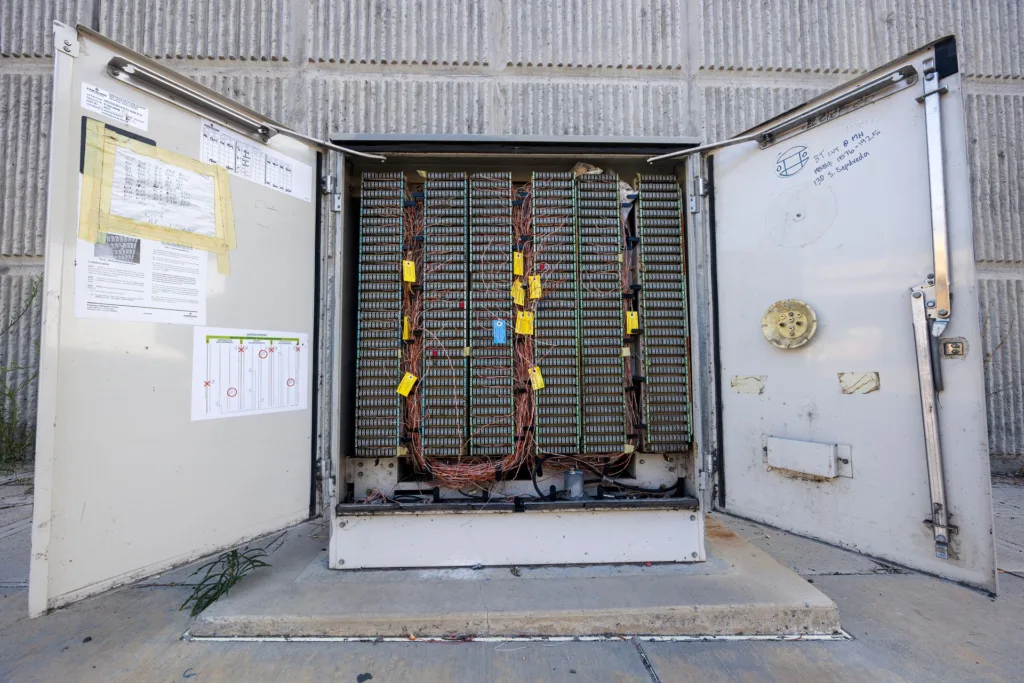
If you recently received a letter from AT&T notifying you that your traditional landline phone service is being discontinued, you are not alone. Across California, AT&T customers are receiving notices as the company moves forward with the retirement of portions of its legacy copper telephone network.
For most people, changing a home or office telephone service is inconvenient but relatively straightforward. For building owners and property managers, however, that old copper line may be doing something far more important. It may be providing the communication connection for an elevator emergency phone, gated entry system, building intercom, area of refuge phone, parking structure call box, or other life-safety communication equipment.
If that describes your property, the AT&T letter should not be ignored, but it also does not necessarily mean you need to replace all of the equipment connected to your existing phone line.
At Destra Business Services (DBS), we specialize in converting existing copper-based emergency and building communication systems to cellular service. In many installations, our Mobile Connect 2 solution allows property owners to retain their existing elevator phone or intercom equipment while replacing the disappearing copper connection that serves it.
Yes, AT&T Really Is Phasing Out Traditional Landlines in California
The transition away from copper telephone service has been discussed for years, but for many California customers it is becoming considerably more immediate.
In May 2026, AT&T filed applications with the Federal Communications Commission to discontinue certain legacy TDM-based residential and business telephone services in portions of 360 California wire centers. According to the California Public Utilities Commission, AT&T estimated that the affected areas include approximately 184,000 residential customers and 15,000 business customers. Customers affected by the proposed discontinuance are required to receive notification from AT&T.
The FCC’s notice lists June 1, 2027 as the authorized date on or after which the affected legacy residential and business services may be discontinued.
AT&T itself has publicly described the transition as part of a broader move away from copper-based services and toward fiber and wireless networks. The company has stated that it is beginning the process of moving customers to newer technologies while discontinuing traditional copper services in portions of California.
In other words, if that AT&T notice arrived at your property, this is no longer a hypothetical future change. It is time to determine what is using that phone line and how it will remain connected after the copper service disappears.
Before You Cancel Anything, Find Out What Is Connected to That Line
This is particularly important for commercial buildings, apartment communities, condominiums, hotels, schools, churches, senior living facilities, parking structures, and other properties with older communications infrastructure.
A telephone number that appears to be an ordinary business line on your AT&T account may actually terminate at an elevator controller, emergency telephone, gate entry panel, intercom or other dedicated device.
Canceling or converting that service without identifying the equipment behind it can leave an important communication system without a working connection.
Before making a change, determine what the line serves. If it is associated with an elevator or other emergency communication equipment, the replacement service should also be evaluated for the applicable operational, monitoring and code requirements of that system.
This is one reason DBS recommends addressing the transition before the existing line reaches its discontinuation date. Planning the conversion while the copper line is still operating gives you an opportunity to install, configure and test the replacement rather than dealing with the problem after communications have already been interrupted.
Your Elevator Phone May Not Need to Be Replaced
One of the misconceptions surrounding the copper phaseout is that replacing the telephone line automatically means replacing the telephone.
In many buildings, that is simply not necessary.
Traditional elevator phones and many other building communication devices were designed to connect to an analog telephone line. What they need is the appropriate telephone interface and a dependable method of carrying the call to the outside network.

That is exactly where Mobile Connect 2 from Destra Business Services comes in.
Mobile Connect 2 provides an interface between compatible existing analog communication equipment and modern cellular service. Instead of relying on the telephone company’s copper network to provide connectivity, the Mobile Connect 2 establishes the connection through the cellular network while providing the interface needed by the existing equipment.
For many properties, this means the original elevator phone can remain in service. There may be no need to replace a functioning emergency telephone simply because AT&T is retiring the copper wires that used to connect it.
Copper-to-Cellular Can Also Work for Intercom and Entry Systems
Elevators are only part of the problem.
Older apartment buildings, gated communities, parking structures, commercial properties and institutional facilities frequently have entry systems that were built around traditional telephone service. Many of these systems continue to operate perfectly well, but the copper telephone infrastructure they depend upon is disappearing.
Replacing an entire intercom or entry system can become an expensive project, particularly when the existing hardware, cabling and stations remain functional.
DBS can evaluate existing systems to determine whether a copper-to-cellular conversion can preserve the equipment already installed while replacing its obsolete telephone connection.
This approach can be especially valuable for properties with older infrastructure. Rather than treating the AT&T phaseout letter as a demand for a complete building communication retrofit, we can first determine whether the existing system can be adapted to modern cellular service.
Why Is AT&T Getting Rid of Copper?
Traditional Plain Old Telephone Service, commonly called POTS, was built around an enormous network of copper wiring, switching equipment and central offices. That infrastructure served California for generations, but the telecommunications industry has increasingly shifted toward fiber, cellular and IP-based networks.
AT&T says only a small percentage of the California households it serves still use traditional telephone service and has described its copper retirement program as part of an effort to invest in newer fiber and wireless infrastructure.
There is also a practical problem with maintaining an aging copper network. Repairs become more difficult to justify as fewer customers remain on the system, and portions of Southern California have experienced repeated copper cable theft. AT&T has issued copper-retirement notices for some distribution areas specifically citing repeated theft of both original and replacement copper cables.
For building owners, the important point is that the economics and infrastructure behind traditional telephone service have fundamentally changed. The question is becoming less about whether copper service will eventually disappear and more about when your particular property needs to make the transition.
Don’t Assume a Standard Phone Replacement Is Right for an Elevator
The AT&T notice may offer newer AT&T telephone options, and those services may be perfectly appropriate for ordinary residential or business voice calls. AT&T itself describes newer cellular-based and digital alternatives as replacements for traditional home telephone service.
An elevator emergency phone or building communication system, however, is not simply another desk telephone.
Before moving one of these systems onto a replacement service, you need to consider the equipment being connected, how calls are initiated and received, power and backup requirements, monitoring arrangements and any applicable elevator, accessibility or local code requirements.
That is where working with a company familiar with elevator and emergency communication conversions becomes important.
DBS does not approach the project as merely changing telephone providers. We look at the communication system that is using the line and determine how that system can continue operating after the copper connection is gone.
Mobile Connect 2 Provides a Practical Path Away From Copper
The goal of Mobile Connect 2 is straightforward: modernize the connection without unnecessarily replacing equipment that still works.
For a compatible system, DBS can replace the dependence on the traditional copper telephone network with a cellular connection while retaining the existing elevator phone, intercom or other communication hardware.
That can eliminate the need for an extensive retrofit and provide a much more manageable path through the AT&T transition.
It also allows building owners to make the change on their schedule rather than waiting for an aging copper line to fail or for its scheduled discontinuation date to arrive.

The Letter Is a Warning, Not a Crisis
If you have received an AT&T copper-service discontinuation notice, there is no reason to panic. There is, however, a very good reason to start planning.
First, identify every telephone line at your property and determine what each one serves. Pay particular attention to lines associated with elevators, gates, call boxes, intercom systems, areas of refuge and emergency communications.
Then determine which systems can be transitioned to cellular service and which, if any, genuinely require replacement.
The sooner that process begins, the easier it is to perform the conversion, test the equipment and address any unexpected compatibility issues while the existing telephone service is still available.
Got an AT&T Phaseout Letter? Call DBS Before You Replace Your Equipment
Destra Business Services has been helping California property owners transition elevator phones and building communication systems from traditional telephone lines to cellular service.
If AT&T has notified you that your copper phone service is being discontinued, send us the notice or give us a call. We can help identify what your existing line is being used for, evaluate your elevator phone or intercom equipment, and determine whether Mobile Connect 2 can provide a straightforward copper-to-cellular upgrade.
Your copper telephone line may be reaching the end of its life. Take a look at our savings calculator to see if service from DBS is right for you.
Your elevator phone or intercom system may not be.
Contact Destra Business Services to learn more about Mobile Connect 2 and your options for converting legacy elevator, intercom and emergency communication lines to cellular service.